Automation Platforms in Manufacturing: From Design Conversion to Cost Estimation
The manufacturing industry is undergoing a digital transformation, driven by automation platforms that reduce manual intervention in design and production workflows.

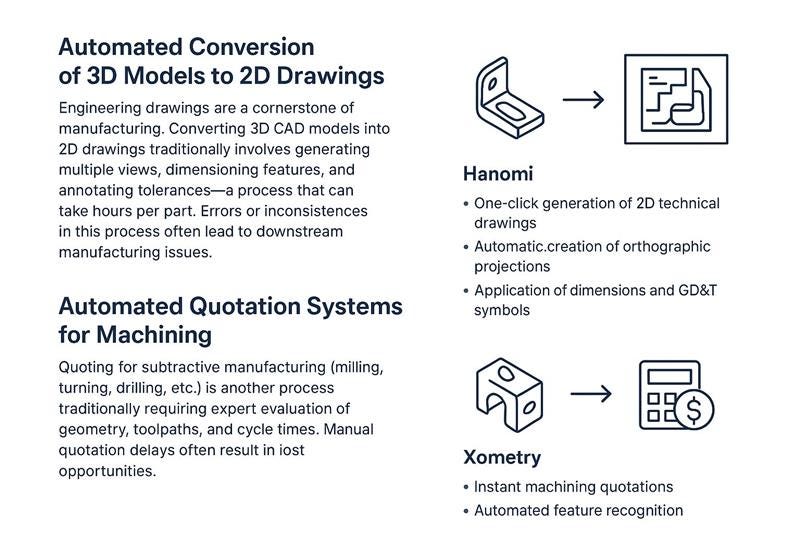
The manufacturing industry is undergoing a digital transformation, driven by automation platforms that reduce manual intervention in design and production workflows. Tasks such as generating 2D technical drawings from 3D models or preparing machining quotations—once labor-intensive and error-prone—are now executed automatically with high precision. This article highlights key advancements in 3D-to-2D drawing automation and AI-driven machining cost estimation, presents real-world platforms such as Hanomi and Xometry, and evaluates the benefits for both small and medium enterprises (SMEs) and large-scale manufacturers.
1. Automated Conversion of 3D Models to 2D Drawings
Engineering drawings are a cornerstone of manufacturing. Converting 3D CAD models into 2D drawings traditionally involves generating multiple views, dimensioning features, and annotating tolerances—an activity that can take hours per part. Errors or inconsistencies in this process often lead to downstream manufacturing issues.
Automation platforms now eliminate this bottleneck.
• Hanomi, for example, provides one-click generation of 2D technical drawings from 3D CAD files.
• The software automatically creates orthographic projections, applies dimensions and GD&T symbols, and ensures compliance with standards such as ISO and ASME Y14.5.
• Material specifications, surface finishes, and other critical annotations can also be automatically integrated into the final output.
This automation reduces engineering workload, improves standardization, and significantly accelerates the transition from design to production.
2. Automated Quotation Systems for Machining
Quoting for subtractive manufacturing (milling, turning, drilling, etc.) is another process traditionally requiring expert evaluation of geometry, toolpaths, and cycle times. Manual quotation delays often result in lost opportunities.
Modern AI-driven platforms solve this problem by automating cost and time estimation.
• Xometry, a global manufacturing marketplace, enables users to upload 3D models or technical drawings and instantly receive detailed quotations.
• The system performs automated feature recognition, estimates machining cycle times, factors in material and finishing options, and outputs accurate cost breakdowns.
• Customers can compare different manufacturing methods or materials in real time, while suppliers benefit from reduced quotation workloads.
This approach shortens the quotation cycle from days to minutes, enabling faster procurement decisions and improved supplier responsiveness.
3. Benefits for SMEs and Large Manufacturers
For SMEs
• Cost Efficiency: Fewer dedicated design and quotation staff are required, lowering overhead.
• Rapid Turnaround: Faster response to customer RFQs (Requests for Quotation) improves competitiveness.
• Scalability: Automation allows SMEs to handle more projects without adding headcount.
• Market Access: By integrating with platforms like Xometry, SMEs can connect with global customers and expand their reach.
For Large Manufacturers
• Standardization: Automated drawing and quotation tools enforce consistency across distributed teams.
• Shorter Lead Times: Streamlined documentation and cost estimation accelerate the entire production lifecycle.
• Digital Integration: Seamless integration with PLM, ERP, and CAM systems supports Industry 4.0 initiatives.
• Strategic Advantage: Faster quoting and documentation give manufacturers an edge in competitive bidding scenarios.
4. Strategic Industry Implications
The convergence of design automation and quotation automation supports the broader vision of smart factories and digital manufacturing ecosystems. By reducing non-value-added engineering tasks, companies can reallocate resources toward innovation, optimization, and customer-focused solutions. For SMEs, these platforms democratize access to advanced capabilities, while for larger organizations, they enable global scalability and operational efficiency.
Conclusion
Platforms such as Hanomi (for 3D-to-2D drawing automation) and Xometry (for instant machining quotations) illustrate how automation is reshaping manufacturing processes. Both SMEs and large-scale manufacturers can achieve significant gains in efficiency, cost savings, and customer responsiveness by adopting such tools. As AI, CAD/CAM integration, and cloud computing continue to evolve, the industry is moving toward a fully automated design-to-production pipeline, where human expertise is focused on innovation rather than repetitive tasks.